Color code
Result1 kΩ
Free tool
Tap the band colors and see the value instantly. It also works the other way round: type a value and get the colors.
Enter the values separated by commas, spaces or line breaks (4k7 or 1M work too) and get the equivalent resistance.
You can mix units: 470, 4k7 and 1M all work. In parallel, the equivalent is always smaller than the smallest resistor.
Quick guide
Each band is a digit, a multiplier or a tolerance; on 6-band resistors, the last one is the temperature coefficient. Read them from left to right, starting at the end opposite the tolerance band, which is usually set slightly apart. 3- and 4-band resistors have two digits; 5- and 6-band resistors have three.
You can check them above: pick the colors and you will get the same value.
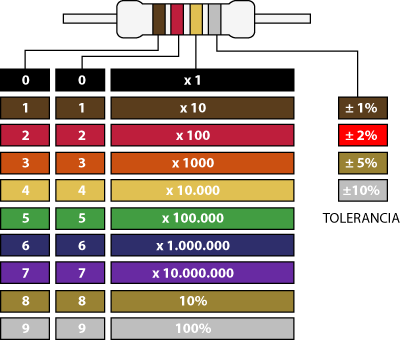
| Color | Digit | Multiplier | Tolerance | Temp. coeff. (ppm/K) |
|---|---|---|---|---|
| Black | 0 | x1 | — | — |
| Brown | 1 | x10 | ±1% | 100 |
| Red | 2 | x100 | ±2% | 50 |
| Orange | 3 | x1,000 | — | 15 |
| Yellow | 4 | x10,000 | — | 25 |
| Green | 5 | x100,000 | ±0.5% | — |
| Blue | 6 | x1,000,000 | ±0.25% | 10 |
| Violet | 7 | x10,000,000 | ±0.1% | 5 |
| Grey | 8 | x100,000,000 | ±0.05% | — |
| White | 9 | x1,000,000,000 | — | — |
| Gold | — | x0.1 | ±5% | — |
| Silver | — | x0.01 | ±10% | — |
| No band | — | — | ±20% | — |
Related
FAQ
You need to read the bands from left to right and identify digits, multiplier and tolerance. This calculator does that automatically when you select the colors.
It usually indicates tolerance or a small multiplier. Gold often represents ±5% or x0.1 and silver ±10% or x0.01.
3- and 4-band resistors have two digits and 5- and 6-band resistors have three, so they give more precise values. A 3-band resistor has no tolerance band (±20%). On a 6-band resistor, the last band is the temperature coefficient: how much the value drifts with heat, in ppm/K.
Type the value in the calculator box (for example 220, 4k7 or 1M) and it marks the colors. A 4-band 220 Ω resistor is red, red, brown and the tolerance band, usually gold (±5%).
Resistors are not made in every value but in standard series. E24 has 24 values per decade: 10, 11, 12, 13, 15, 16, 18, 20, 22, 24, 27, 30, 33, 36, 39, 43, 47, 51, 56, 62, 68, 75, 82 and 91, multiplied by 1, 10, 100… If the value you need is not there, the calculator shows the two closest ones.
Next step
If you need more than electronics calculations and want professional help developing a device or prototype, you can visit our service page or contact RobotUNO.