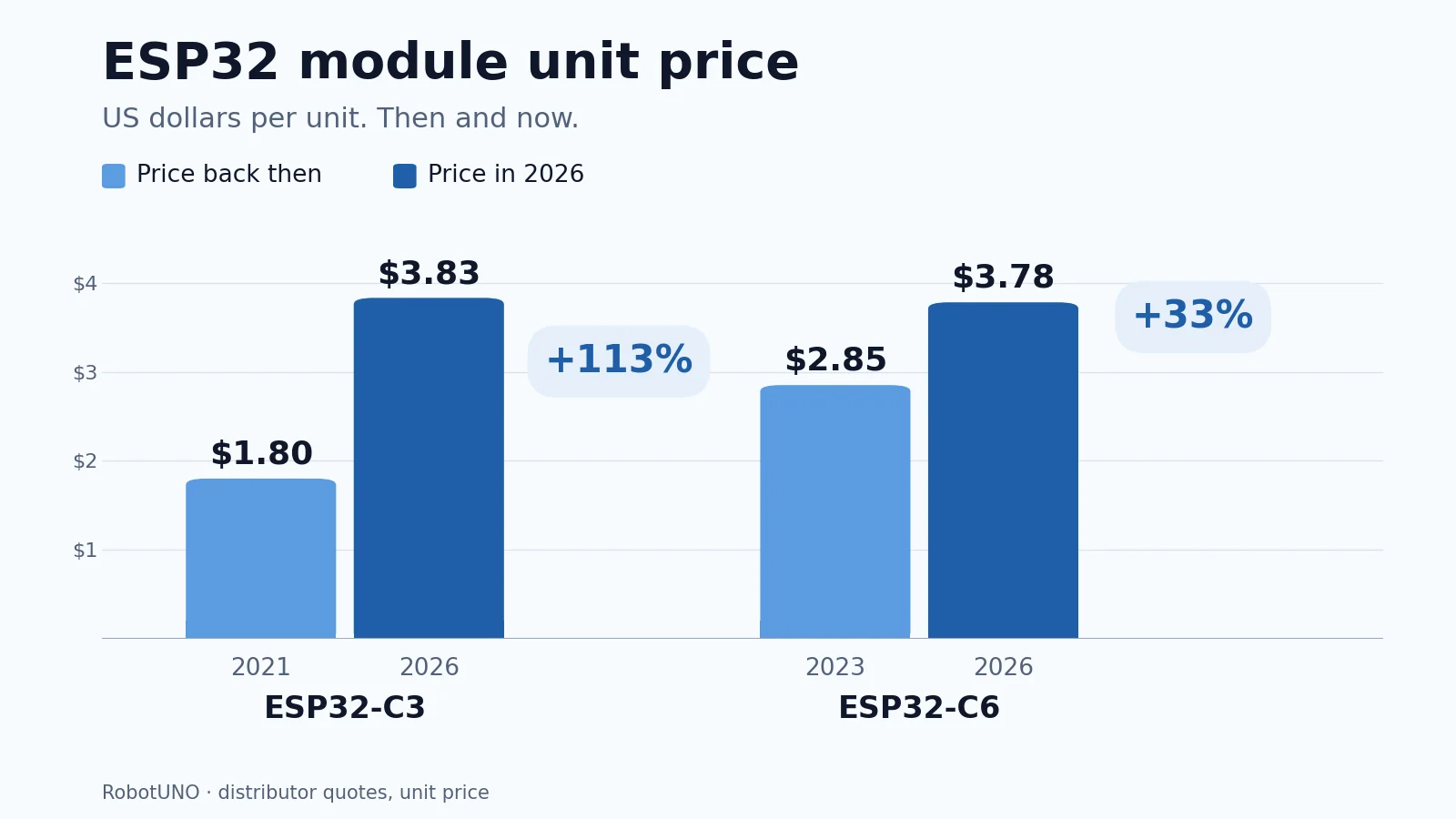
In 2021, the ESP32-C3 module cost $1.80. Today it is $3.83 per unit. More than double in five years. And it is what we are seeing every week with our clients.
A couple of years ago, the biggest worry in a project was stock. That has not gone away. But now there is a new problem: the price you budgeted six months ago is no longer the price you will pay when it is time to manufacture.
If you set your selling price from the prototype quote, this article is for you. By the time production arrives, your margin may have evaporated without anyone touching the design.
Table of contents
Not an isolated case
The ESP32-C3 is not an exception. Another one we checked: the ESP32-C6 cost $2.85 in 2023 and is $3.78 today. That is +33% in under three years.
And behind it there are steeper rises. NOR flash alone went up by 100 to 120% in the first half of 2026. It is the memory that holds the firmware of countless products, and it sits inside many ESP32 modules. When flash goes up, the module goes up.
The chart at the top sums it up: two modules widely used in connected products, and neither costs what it did when many of the products being built today were designed.
Let's do the numbers
A quick, illustrative calculation with the ESP32-C6: $0.93 more per unit, on the module alone, is $930 on a run of 1,000 units. With the C3 the difference is $2.03 per unit: over $2,000 per thousand.
And it does not stop there. That extra cost drags the margin of every link in the chain all the way to the final price. If the chain multiplies your cost by 2.5 to reach the retail price, those $0.93 become around $2.30 on the shelf.
Why it hurts more than it seems
If the selling price is already fixed, the customer does not pay for the increase: you absorb all of it. An example with round figures:
- You budget a manufacturing cost of $20 and agree a selling price of $30. Margin: $10.
- When it is time to build, the BOM has gone up by 10%. The cost is now $22.
- Your margin drops to $8. A 10% cost increase has taken away 20% of your margin.
The tighter the margin, the harder the hit. With thin margins, a moderate BOM increase can wipe out the profit on the whole order.
Now multiply it across the whole BOM
The module is only one line. Memory, PCB, passives, connectors... Everything goes up a little, and all at the same time.
No single increase looks serious on its own. 5% here, 15% there. The problem is that they add up, and nobody looks at them together until the invoice for the production order arrives. If you are also building boards at volume, it pays to be clear about where to save and where not to, because cutting in the wrong place is expensive.
From a stock problem to a price problem
During the 2021–2022 semiconductor shortage, the question was "is there stock?". Products sat on hold because a component worth a few cents would not arrive.
That question still matters. But now there is another one to ask: "at what price?". The component is there and you can buy it, just not at the price the budget was built on. And because it does not stop the line, it goes unnoticed until the order's numbers are closed.
The most common mistake
The one we see most is this: setting the selling price from the prototype quote, with no validity date and without securing the critical components.
Months pass between prototype and production: validation, certification, design tweaks, a pre-production run. Months in which BOM prices keep moving. When production arrives, the number the product was sold at no longer matches what it costs to build.
Quick test: find the date of the quote you used to set your product's selling price. If it is more than three months old and you have not reviewed it, you do not know your margin.
How to protect yourself: plan ahead
That is why we keep insisting on the same thing: plan ahead. Specifically, four things.
1. Review the BOM every few months
You do not need to re-quote all two hundred lines. Usually a handful of components account for most of the cost: modules, microcontrollers, memory, the PCB. Those are the ones to re-quote every few months, and always before a quote or a production order. While you are at it, check whether any of them has reached end of life.
2. Buy critical parts in advance
Expensive parts, long-lead-time parts and parts with no alternative get bought as soon as the design is frozen, not when production starts. It ties up cash, yes, and they need proper storage: modules and many chips are moisture-sensitive and must be stored according to their MSL rating. But it locks in the price and lead time of what matters most.
3. Have a second source
For passives it is easy: there are dozens of equivalents. For a module or a microcontroller it is harder, because changing it affects the firmware and, if it has a radio, may mean reviewing the CE marking. That is why a second source is prepared at design time: footprints that accept two variants, a second distributor for the same part number, alternatives validated before you need them.
4. Quote with prices that expire
A manufacturing quote with no validity date is a promise you do not control. Give it a short validity, state which components may vary, and how the price is reviewed if they do. It gives your customer an honest forecast and protects your margin.
How we approach it at RobotUNO
When a product is on its way to manufacturing, we track cost the same way we track the design:
- We identify the BOM lines that carry most of the cost and the ones with no alternative.
- We re-quote them before every quote and every order, and flag it when one spikes.
- We recommend what to buy in advance and which alternatives to plan into the design.
- We quote with a validity date, making clear which components are exposed to price rises.
It is part of the cost study and optimization for taking a prototype to market and of our industrialization and mass manufacturing work. And if your product uses an ESP32, we also have an ESP32 FAQ.
Frequently asked questions
Is it only the ESP32 that is going up?
No. It is a clear example, but memory, PCBs and passives are going up too. Each increase looks small on its own; the problem is that they all arrive at once and add up in the BOM.
How often should I review the BOM?
Every few months on an active project, and always before giving a quote or placing a production order. You do not need to re-quote every line: the few that carry most of the cost are enough.
Is it worth buying components in advance?
For critical parts, yes: expensive parts, long-lead-time parts and parts with no alternative. It ties up cash and needs proper storage, but it locks in the price and lead time of what weighs most in the product.
What is a second source?
A validated alternative for a component: an equivalent part number, another manufacturer or, at the very least, another distributor for the same part. For passives it is simple; for modules and microcontrollers it has to be prepared at design time.
How long should a manufacturing quote be valid?
Short, especially in today's market: weeks, not months. And it should state which components may change in price and how the quote is reviewed if they do.
Is your manufacturing quote more than three months old?
We can review your BOM, re-quote the lines that carry the cost, and tell you what to buy now and which alternatives to plan for before production.