On 1 October, the CPSC, the US Consumer Product Safety Commission, announced two recalls of rechargeable hand warmers: around 77,000 HotHands units from Kobayashi and around 5,500 from Gobi Heat. Same hazard, near-identical product descriptions and no incidents reported.
In both notices, the manufacturer listed is the brand company, and the country of manufacture is China. For anyone selling electronics under their own logo, that is the lesson: if you put your brand on an off-the-shelf product, you inherit its design. And its recall.
The key idea: a white-label product is not just a purchase. It is a design you did not make and are answerable for. Before you put your brand on anything with a lithium battery inside, ask for the documentation of the cell and its protection, and check that there is a thermal cut-off that does not depend on the firmware.
Table of contents
What has been recalled
These are two separate CPSC notices, published on the same day:
- HotHands, from Kobayashi: around 77,000 units in the US and 72 in Canada. White with orange accents, sold from July 2025 to August 2026 for $30 to $40, at major retailers such as Target and The Home Depot and on Amazon.
- Gobi Heat: around 5,500 units in the US and 47 in Canada. Black with gray accents, sold on the brand's own website from October 2024 to August 2026 for $20 to $40.
Both notices describe the hazard in the same words: the lithium-ion battery and electrical components can overheat and ignite, posing a risk of serious injury from fire and burns. Neither reports any incidents or injuries. Both offer a refund, and both ask consumers not to throw the product in the trash or recycling bin but to take it to a hazardous waste collection site.
And the product descriptions are almost identical: pairs of warmers that join magnetically, USB-C charging, adjustable heat, LED indicators, a hard plastic shell and a silicone lanyard.
What we do not know: the CPSC does not publish the root cause, and there is no evidence that the two products come from the same factory. We are not claiming they do. But the pattern is readable without that.
White label: the design comes included
A white-label product is designed and built by another company, often an ODM, and you sell it under your brand. It is the fastest route to having a product: pick it from the catalog, change the color, add the logo and place the order.
What is not always visible is everything that comes with that purchase: which cell it uses, what protection it has, how much thermal margin was left and which tests were run. Those decisions were made by whoever designed the board, not by whoever signs the box. But when something goes wrong, the recall carries the name on the box.
In the European Union it works the same way, in writing. Regulation (EU) 2023/988 on general product safety, applicable since 13 December 2024, defines the manufacturer as anyone who manufactures a product "or has a product designed or manufactured, and markets that product under that person's name or trademark". CE marking legislation uses the same idea. In other words: if the logo is yours, so are the manufacturer's obligations.
We are not lawyers and this is not legal advice. What we do know is which technical side needs to be in place. With a battery, the cell regulations and the transport rules come on top, and we cover them in CE marking for battery-powered products.
Lithium and heat in the same enclosure
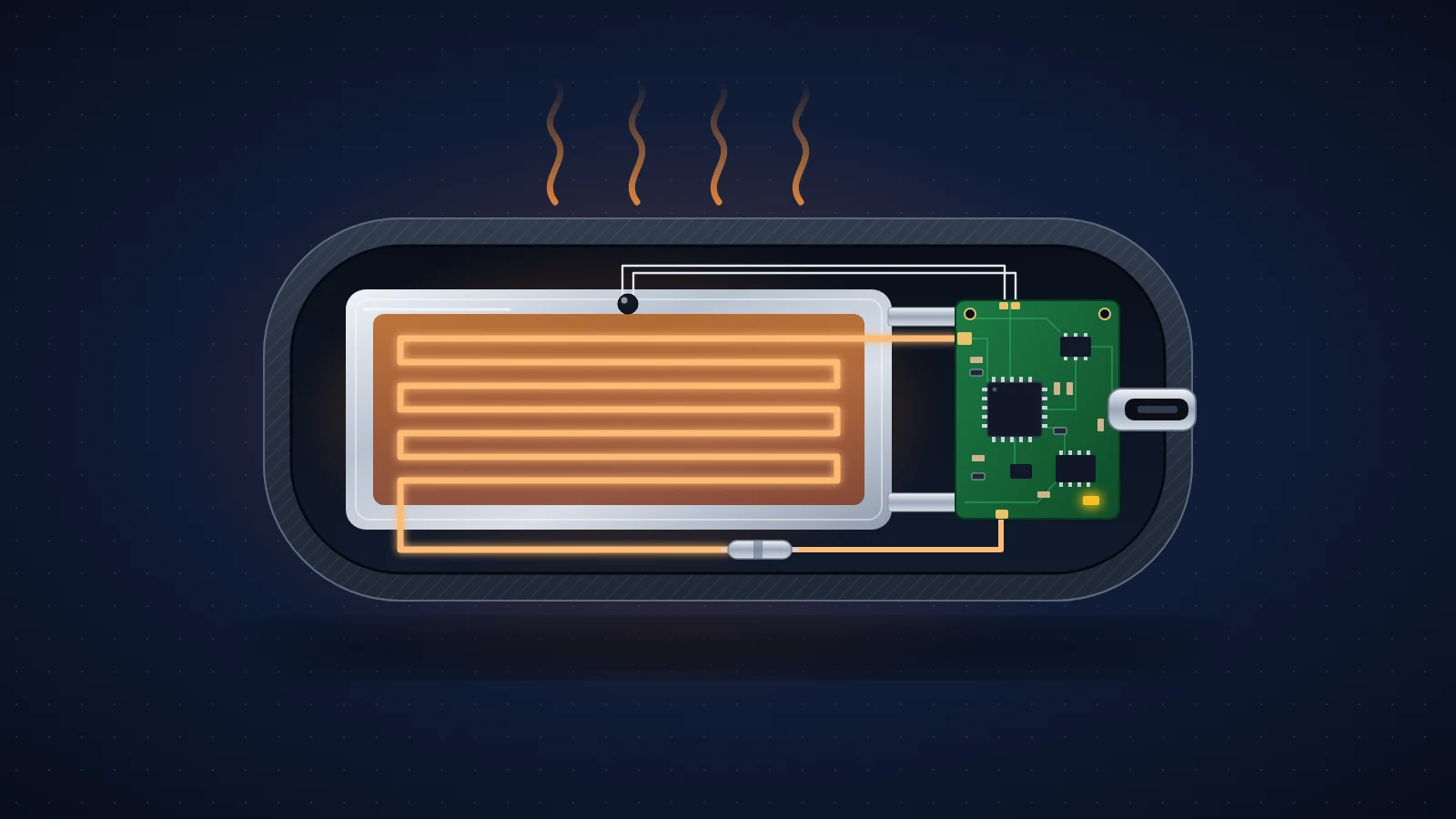
A rechargeable hand warmer puts two things that already need care on their own into one closed enclosure: a lithium cell and an element that heats up on purpose.
A typical lithium-ion cell can be charged between 0 and 45 °C and discharged up to about 60 °C; the exact limits are in each cell's datasheet. A hand warmer is designed to keep its surface hot for hours, a few millimeters from that cell.
And the cell does not only receive heat: it generates it too. An illustrative example: a 5 W heater running from 3.7 V draws about 1.35 A continuously. That current heats the cell itself through its internal resistance, just as the heater warms it from the outside.
Now add what users will do without thinking: use it while it charges, leave it on maximum inside a pocket or a glove, charge it next to a radiator. The thermal margin between the heater and the cell is the main design constraint. And in a white-label product, someone else decided that margin.
What to ask for before you add your brand
The minimum before you sign with a manufacturer for a product with a lithium battery:
1. The cell documentation
A datasheet with the exact manufacturer and part number, the IEC 62133 test report and the UN 38.3 test summary for transport. If the cell is "generic" and nobody can tell you who makes it, that is already an answer.
2. The protection schematic
What protects the cell against overcharge, deep discharge, overcurrent and short circuit, and what controls temperature during charging. "It has protection" is not enough: ask for the schematic and the part number of each IC.
3. Worst-case tests
The cell temperature with the heater on maximum while charging, inside a closed space and at the highest expected ambient temperature. Measured with a thermocouple on the cell, not on the enclosure.
4. Change control
A written commitment that they will not change the cell or the protection components without telling you. A batch can ship with a different "equivalent" cell without anyone mentioning it.
5. Batch traceability
A batch number on the product and a record of which components went into each batch. The CPSC notices identify the products by model number and, for HotHands, by batch number too. If a recall is ever needed, traceability is what tells you exactly which units are affected.
Without all of that, you are not buying a product. You are buying a risk with your brand on it.
A thermal cut-off that does not depend on firmware
In many heated products, temperature control is done by the microcontroller: it reads an NTC, regulates the power and switches off if it gets too hot. That is fine as a first layer. The problem is when it is the only one.
If the only protection is an NTC read by the micro, a software failure switches it off. A hang with the heater output on, a bug in an update or a sensor that comes loose and reads a false temperature, and there is nothing left to cut the power.
That is why thermal protection is designed in layers:
- Firmware: power regulation, software limits and a watchdog that resets the micro if it hangs. Plus a circuit that keeps the heater off by default while the micro boots, for example a pull-down resistor on the MOSFET gate that holds it off.
- Charger with temperature control: many charger ICs read their own NTC and suspend charging outside the safe range, without going through the micro.
- Cell protection: the circuit that disconnects on overcharge, deep discharge and short circuit, independent of everything else.
- Physical thermal cut-off: a thermal fuse or a bimetallic thermostat in series with the heater. If the temperature is exceeded, it opens the circuit, whatever the software is doing.
None of these layers is expensive. What is expensive is finding out one was missing once the product is already on the market.
Quick check: look in the documentation of your battery-powered product for the temperature at which it stops charging and what stops it: the micro or a component. If it is not written down, you have your first question for your manufacturer.
What these recalls do not tell us
It is worth not drawing more conclusions than the data supports.
A recall with no incidents is, in part, a good sign. Someone spotted the risk and the product is being withdrawn before the first fire. That is how it should work.
The cause is not known. It could be the cell, the protection, the heater or the assembly. That is why this article is not about what failed in these products, but about what is worth checking in yours.
Your own design is not immune. If you design the product yourself, this particular risk, signing off on something you do not know, goes away. Others appear: choosing the right cell, sizing the protection and testing it properly. The difference is that you make those decisions and you know why.
White label is not bad by definition. It is a legitimate way to reach the market quickly. You just have to treat it for what it is: a design to be reviewed, not a purchase you simply pay for.
How we approach it at RobotUNO
In a battery-powered product, thermal design and protection are decided at the start, not at the end:
- We choose cells from an identified manufacturer, with test documentation.
- We design protection in layers and, when there is a heating element, with a cut-off that does not depend on the firmware.
- We plan tests around the worst case: charging, at full power and in the most enclosed space expected.
- If you are starting from an existing product, our initial research compares what is on the market, buys it and tests it before deciding whether to adapt it or design from scratch.
It is part of electronic product development and of the path from prototype to market, which also covers CE marking and testing.
Frequently asked questions
Which hand warmers have been recalled?
On 1 October 2026, the US CPSC announced recalls of around 77,000 HotHands rechargeable hand warmers from Kobayashi and around 5,500 from Gobi Heat, plus small quantities sold in Canada. The reason is that the lithium battery and electronics can overheat and ignite.
What should I do if I have one of the recalled hand warmers?
Stop using it and follow the instructions in the CPSC notice for its brand, which offers a refund. The notices ask consumers not to put it in the trash or recycling bin, but to take it to a hazardous waste collection site.
What is a white-label product?
A product designed and built by another company, often an ODM, and sold under the buyer's brand. It is quick to launch, but the design, with all its safety decisions, comes included.
Who is responsible if a white-label product fails?
In the European Union, Regulation (EU) 2023/988 treats anyone who has a product designed or manufactured and markets it under their name or trademark as the manufacturer, so they take on the manufacturer's obligations. For a specific case, consult a legal specialist.
Why is a product with a lithium battery and a heater delicate?
Because it puts a cell with temperature limits and an element that heats up on purpose in one closed enclosure. On top of that, the cell heats up as it supplies the heater's current. The thermal margin between the two is the main design constraint.
What is a thermal cut-off that does not depend on firmware?
A component, such as a thermal fuse or a bimetallic thermostat, that opens the heater circuit if a temperature is exceeded, without relying on the microcontroller. It still protects if the software hangs or a sensor fails.
Are you launching a product with a lithium battery?
We can review the cell, the protection and the thermal design before you put your brand on it, whether you are designing from scratch or starting from an existing product.