
What if not everything had to be black or white? What if, besides 0 and 1, there were also a 2?
Let's take a look, because this is not some brand-new wild idea. Ternary logic was explored more than half a century ago. But let's go step by step.
Today, almost all the technology we use works with binary logic. From a microcontroller to a computer, everything is based on two states: on or off, high or low, yes or no. In other words, 1 or 0.
This system has its roots in the work of the mathematician George Boole in the nineteenth century. Years later, Claude Shannon showed that this logic could be applied to electrical circuits, and that became the starting point for everything we now understand as computing.
But what if we were not limited to only two states?
What would happen if circuits could work with three distinct values instead of two?
That is where ternary logic appears: an alternative that was once taken seriously and that, although largely forgotten, could make sense again in the not-so-distant future.
Could circuits work if we used ternary logic instead of binary? Yes, and it is more than a simple curiosity. Ternary logic exists, it has been tested in real computers, and it offers a completely different way of understanding how information flows through a circuit.
While binary logic reduces everything to two states, 0 and 1, off and on, ternary logic introduces a third value. Instead of a simple yes or no, it adds a middle point, a third state. That third value can be represented as -1, 0 and 1, or as low, medium and high, depending on the context.
This is not just theory. In the late 1950s, in the former Soviet Union, a computer called Setun was developed using ternary logic. It used electronic components designed specifically to work with three different voltage levels instead of the two classic levels of binary electronics.
The idea behind this was simple but powerful: with three states you can represent more information with fewer digits. A single trit, the ternary equivalent of a bit, can store more than one bit. In theory, that would allow more efficient circuits capable of doing more with less.
Of course, all of this comes with trade-offs. But before getting into the limitations, it is worth understanding what those circuits would actually look like and what theoretical advantages they could have over binary ones.
So what would those ternary-logic circuits actually look like?
Instead of working with just two voltage levels, as binary logic often does with 0 V and 3.3 V for example, here we would have three. You can imagine something like 0 volts for 0, 1.65 volts for an intermediate value and 3.3 volts for 1. Each of those levels would represent one of the three possible logic states.
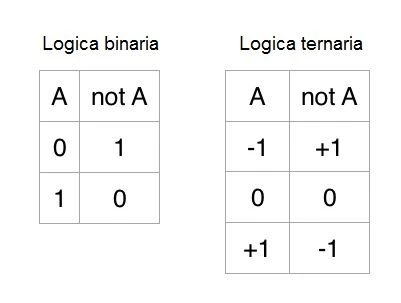
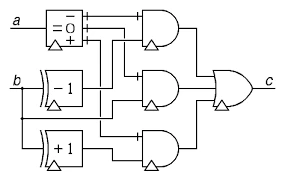
That forces a complete redesign of the classic logic gates. Standard AND, OR and NOT gates no longer work as they are. You would need adapted versions, or even entirely new ones. For example, majority gates that drive the output according to the most common input value, or gates that compare levels to determine whether something is below, equal to or above a threshold.
All of this sounds very good on paper and, visually, these circuits could be more compact. Because each line carries more states, you can reduce the number of signals needed to represent the same information. But not everything is an advantage: they also become more complex to design, more sensitive to electrical noise and harder to manufacture with the standard components we use today.
Pros and Cons of Ternary Logic Compared with Binary
Although ternary logic has interesting advantages over binary, it also comes with important limitations. Because it uses three states instead of two, you can encode more information with fewer signals. That means circuits could theoretically be more compact, and fewer data lines would be needed to transmit the same amount of information. In some algorithms, mathematical operations could also become more efficient.
But all of that runs into the reality of modern electronics. Implementing ternary logic with conventional transistors is difficult. On top of that, when you work with three voltage levels, circuits become more sensitive to electrical noise, which increases the chance of errors. And the biggest factor is this: the whole industry, from programming languages to protocols such as USB or HDMI, is built around binary logic. Changing that foundation is not just difficult; with today's infrastructure, it is almost unworkable.
Does It Have a Future?
Although ternary logic is not used commercially today, that does not mean it is dead. In fact, with the advance of new technologies such as optical computing and hardware-level AI systems, more and more research is willing to look beyond the classic 0 and 1.
Even in fields such as quantum computing, where qubits can exist in multiple states at once, it is clear that other forms of logic are possible. Ternary logic, although left aside for decades, could return in a future where storing and processing more information with fewer resources becomes a real need.
Who knows? In a few years, we may once again see circuits that no longer think only in black and white, but can also operate in the greys.